11527 Giovanni Battista Piranesi (1720–1778) – View of the Arch of Septimius Severus – Etching (1772)

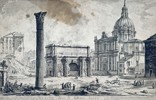
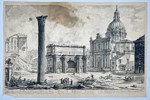
"Arco di Settimio Severo." This etching presents a dramatic topographical view of the Roman Forum, centering on the triumphal Arch of Septimius Severus. The composition utilizes Piranesi's signature low perspective to emphasize the monumental scale of the ancient architecture, showing the arch partially buried in the accumulated earth of the Campo Vaccino. To the left stands the solitary fluted column of the Temple of Phocas, while the right side of the plate features the Baroque facade of the Church of Santi Luca e Martina with its prominent dome. In the background, the medieval and Renaissance structures of the Capitoline Hill are visible. Small, gestural figures are scattered throughout the scene, providing a sense of scale and highlighting the contrast between the grandeur of Rome's imperial past and the rural character of the site in the eighteenth century. This plate was published in Rome as part of the celebrated series Vedute di Roma.
Giovanni Battista Piranesi was a highly influential Italian artist, architect, and theorist renowned for his etchings of Rome and his atmospheric "Carceri" or prison interiors. Born in Venice and later based in Rome, he dedicated his life to documenting the city's ancient ruins, combining meticulous archaeological observation with a romantic, visionary sensibility. His technical mastery of the etching medium allowed him to create unprecedented tonal depth and textural variety, influencing generations of artists, architects, and stage designers. Piranesi's work played a fundamental role in the development of Neoclassicism and the Romantic fascination with the sublime and the passage of time. His vast graphic output remains the most iconic visual record of the Eternal City during the Enlightenment era, capturing both the physical reality and the poetic spirit of classical antiquity.
Artist or Maker: Giovanni Battista Piranesi.
Dimensions: Approximately 40 cm x 60 cm.
Medium: Etching.
Date: 1772.
Condition Report:
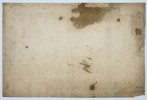
This work is in good condition overall. There may be a few minor imperfections or fox or mottled marks to be expected with age. Please review the images carefully for condition details, and feel free to contact us with any questions or for a comprehensive condition report.
| Estimate | 400 - 500 SEK |
| Buyers Premium (inc. VAT) | 24.8% |
| Hammer Fee (inc. VAT) | 6 SEK |
Dahlströms Rare Prints
Harju maakond, Tallinn
Lasnamäe linnaosa, Ruunaoja tn 3, 11415
Estland
info@dahlstromsrareprints.com





© Software Copyright 2026 Skeleton. All rights reserved.